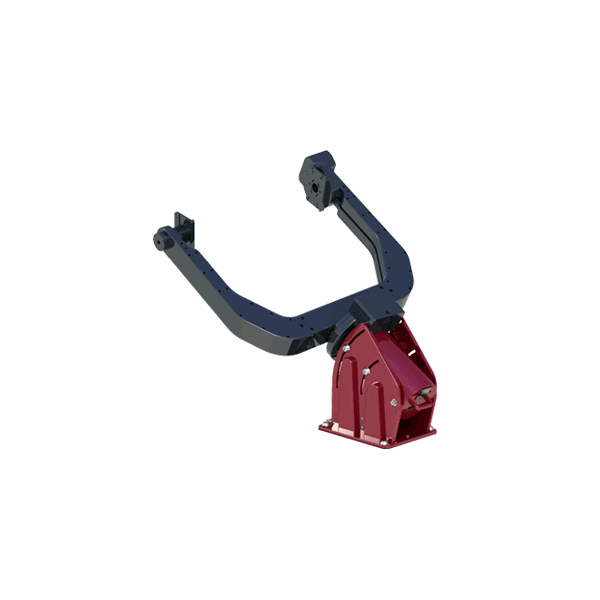
The Software Bisque Taurus marries a compact fork mount for large format telescopes with the brilliant design, engineering and features of a Paramount.
Load capacity of 400 pounds.
This variant is sized for scopes of 0.6m in size.
Other variants are readily available, and some degree of customization is possible.
Breaks down into 5 manageable pieces.
The Taurus mount can be set up by one person if necessary.
This version is packaged with the required on-axis encoders.
Configurable polar axis suitable for most locations.
All Paramount Taurus™ equatorial-fork models deliver uninterrupted horizon-to-horizon imaging. That is, there are no interruptions for meridian flips compared to German equatorial mountings.
All Taurus models are equipped with high-performance direct-drive motors and on-axis absolute encoders. That means silent operation and much faster slew speeds. It also means no homing is required and periodic error is negligible.
Hardware Specifications
400 lb. (180 kg) instrument capacities Taurus 500/600
600 lb. (370 kg) instrument capacity Taurus 700
All sky pointing accuracies at or below 30 arcseconds RMS1 (see Software Specifications below for more details)
3-axis industrial direct drive control system
Tracks objects up to six (6) hours beyond meridian
No meridian flips or protruding counterweights
No homing required
Slews up to 30 degrees per second
Direct drive motors deliver 37 Nm continuous torque in both the hour angle and declination axes
All electronics and cables are housed inside the mount with ample room for additional cables
26-bit on-axis absolute encoders provide resolution of 0.02 arcseconds on each axis
Connect via Ethernet
Integrated power supply included
Durable and fade-resistant red powder coating and black anodized finish. Mount is primarily constructed from machined 6060 and 6061 aluminum alloy; mount base is power coated steel.
Integrated azimuth and elevation polar alignment adjustments
Counterweight system corrects imbalances from asymmetries in the optical tube and imperfect centering between fork tines
Optional Scope Rail System lets you easily change your imaging equipment by moving instruments fore and aft along optical axis
Exceptionally comfortable access to eyepieces
Software Specifications
Paramount’s unsurpassed pointing and tracking wouldn’t be possible without its TPoint™ and ProTrack™ software.
By employing TPoint’s calibration and telescope modeling tools, you’ll enjoy all sky pointing accuracies below 30 arcseconds RMS.1 Nothing outperforms that.
Operating in conjunction with TPoint™, ProTrack™ continuously updates the mount’s position across both axes to correct system-wide tracking errors including tube flexures, atmospheric refraction, polar misalignment, harmonic errors from miscentered encoders, and more.
While on-axis absolute encoders eliminate periodic error2, they cannot correct all those other errors — only a properly applied telescope model can achieve that.
Gear-driven Paramounts without encoders deliver 5-to-10-minute unguided exposures with many enjoying up to 20 minutes (see example in this ad). Our direct-drive models are better still.
Our direct drive mounts can be controlled directly using software that’s different than ours. You could also separately license our professional version of TPoint™ and TCSpk™ to enjoy superior pointing and tracking results.
The included TheSky™ Universal bundle comes with TheSky™ Professional, TPoint™, Cameras+, Domes, Multi-OS+, and Weather modules.
The Satellites module for mission-critical, scripted and ephemeris-based satellite tracking is also include.
Supported operating systems include Windows™, macOS™, and Linux (on arm64, x86_64 architectures).
Regardless of the operating system used, the application appears and operates identically. You can even switch between operating systems and its license allows up to six computers. Why paint yourself or your institution into a corner?
1Performance specifications are based on our gear-driven models. Direct-drive Paramounts deliver significantly better results.
2The periodic error caused by slight mechanical imperfections in the mounting of the ring encoders is virtually zero.